

ASIC Miners: How They Work and How to Choose the Right Model for Bitcoin Mining

The ASIC miner is the hardware component at the core of modern Bitcoin mining. Designed to execute the SHA-256 algorithm with extreme efficiency, it is now the standard used by professional mining farms around the world.
In this guide, we will explain how an ASIC miner works, which key specifications to evaluate before purchasing, why energy efficiency has become a decisive factor, and which mistakes to avoid when choosing your hardware. We will also see why, in professional mining, simply purchasing a powerful machine is not enough: you need the right infrastructure, an efficient cooling system, and continuous performance management.
At Bcrypto, we select the latest-generation ASIC miners and integrate them into an ecosystem designed to maximize reliability, operational continuity, and long-term efficiency.
Table of contents
What Is an ASIC Miner and Why Is It at the Heart of Bitcoin Mining
Bitcoin mining starts with a fundamental piece of hardware: the ASIC miner (Application-Specific Integrated Circuit). Unlike a standard computer, an ASIC is not designed to perform general-purpose tasks but is developed to execute one specific function extremely efficiently: calculating billions of SHA-256 hashes every second, the algorithm used by the Bitcoin protocol to validate blocks on the blockchain.
This specialization is why ASICs have progressively replaced CPUs, GPUs, and FPGAs in Bitcoin mining. While the first generations of miners used traditional processors, the increasing difficulty of the network has made increasingly efficient hardware necessary, capable of producing a much higher number of hashes while consuming less energy. Today, professional mining is almost exclusively carried out using dedicated ASICs, designed to provide the best balance between computing power and energy efficiency.
From CPU to ASIC: The Evolution of Mining
Generation | Characteristics | Why It Was Replaced |
CPU | General-purpose processors used in the early years of Bitcoin | Limited computing power and high energy consumption |
GPU | Greater parallelization of calculations compared to CPUs | More efficient, but not designed exclusively for SHA-256 |
FPGA | Reconfigurable circuits with higher efficiency than GPUs | High costs and greater development complexity |
ASIC | Integrated circuits designed exclusively for SHA-256 mining | Today, they represent the industry standard thanks to their high energy efficiency |
Today, therefore, talking about Bitcoin mining means talking about ASIC miners. However, choosing a machine based solely on its hashrate would be a mistake: energy efficiency, the cooling system, and the infrastructure in which the ASIC is installed matter just as much as its computing power. These are precisely the factors that determine the competitiveness of a modern mining farm.
How an ASIC Miner Works
An ASIC miner performs a single function: executing as many SHA-256 calculations as possible to contribute to the validation of blocks on the Bitcoin blockchain. Every second, the machine processes billions of attempts in search of a hash that meets the difficulty level set by the network.
In practice, the process begins when the mining pool sends the ASIC the data needed to start working. The miner then receives a “job”, a set of information it will use to continuously generate new hashes by modifying the nonce value. If one of the results meets the network requirements, the work is sent to the pool, which verifies the result and, if the block is validated, distributes the reward among participants according to the established rules.
The operational flow can be summarized as follows:
Mining Pool → ASIC Miner → Hash Calculation → Share Submission → Block Validation → Reward Distribution
At this point, it is important to distinguish between some terms that are often confused:
Hashrate = indicates the ASIC’s computing power, expressed in TH/s (terahashes per second).
Share = proof of the work performed by the miner and submitted to the pool.
Valid block = the result that meets the difficulty level required by the Bitcoin network.
Reward = the reward distributed by the pool to the miners who contributed to block validation.
✔ The higher the ASIC’s computing power and the greater its energy efficiency, the higher the probability of contributing to the production of new blocks while keeping energy consumption under control.
How to Choose an ASIC Miner: The Parameters That Really Make a Difference
Two ASIC miners can deliver very different performance even if they belong to the same generation. Focusing only on price or hashrate is often a mistake. The right choice should always consider the balance between performance, energy consumption, and operating environment. Here are the most important factors to evaluate.
Hashrate (TH/s)
Hashrate represents the miner’s computing power and indicates how many terahashes it can process every second. A higher value means greater theoretical computing power, but it does not automatically guarantee higher profitability: energy consumption must always be taken into account as well.
Energy Efficiency (J/TH)
This is probably the most important parameter. It measures how much energy is required to produce one terahash and is expressed in joules per terahash (J/TH). The lower this value, the more efficient the miner is and the lower its long-term operating costs will be.
Electricity Consumption
An ASIC operates 24 hours a day and can draw several kilowatts of power. Electricity consumption directly affects energy costs, as well as the sizing of the electrical system and the cooling capacity required by the facility.
Cooling System
Temperatures affect both performance and hardware lifespan. Today, ASIC miners can use air cooling or hydro cooling, a solution that makes it possible to manage higher computing densities while maintaining more stable thermal control. The choice depends on the available infrastructure and the objectives of the system.
Reliability and Operational Continuity
A miner generates value only when it is running. Therefore, it is also important to consider factors such as build quality, ease of maintenance, availability of spare parts, firmware stability, and continuous performance monitoring.
Which ASIC Miner Should You Choose? BCrypto Solutions for Professional Mining
At BCrypto, we exclusively offer latest-generation ASIC miners, selected to provide the best balance between performance, energy efficiency, and reliability.
ASIC Antminer S21 PRO 234T

The Antminer S21 PRO is an ideal solution for those looking to enter professional mining with a high-performance machine that offers an excellent balance between hashrate and efficiency. It is particularly suitable for air-cooled infrastructures and provides an optimal balance between initial investment and productivity.
ASIC Antminer S21 XP 270T

For those looking to maximize computing power, the Antminer S21 XP takes hashrate to a higher level while maintaining high energy efficiency. It is designed for those who want to increase productivity without compromising optimized energy consumption and operational continuity.
ASIC Antminer S21 Hydro 470T
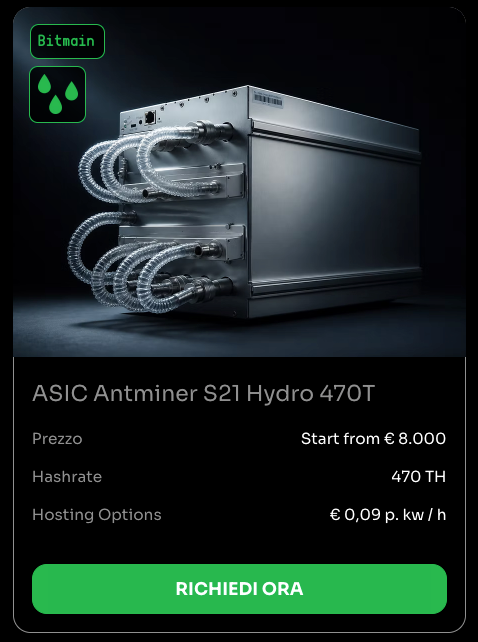
The Antminer S21 Hydro is designed for professional infrastructures that use liquid cooling. Thanks to its high hashrate and Hydro Cooling system, it enables higher computing density and more stable thermal management, features that are particularly valuable in next-generation mining farms.
Why an ASIC Alone Is Not Enough to Mine Bitcoin Efficiently
Choosing a latest-generation ASIC is an excellent starting point, but it is not enough to ensure consistently high performance over time. In professional mining, the performance of a machine also depends on the environment in which it operates and the infrastructure supporting it.
Even a highly efficient ASIC can lose part of its potential if installed in a non-optimized environment. Conversely, a properly designed infrastructure makes it possible to maintain high performance, reduce downtime, and preserve the hardware over the long term.
For this reason, professional mining farms evaluate several factors in addition to the specifications of the machine itself:
Stable power supply, properly sized to support the continuous operation of ASICs;
Adequate cooling system, essential for maintaining optimal operating temperatures and ensuring service continuity;
Professional hosting, designed to house ASICs in controlled, highly efficient environments;
Continuous performance monitoring, to quickly identify any anomalies and reduce downtime;
Preventive maintenance, essential for preserving hardware reliability and efficiency over time.
Together, these elements determine the competitiveness of a mining operation. While the ASIC is the heart of the infrastructure, it is the ecosystem built around the machine that makes the difference between a basic installation and a mining farm designed to operate efficiently and continuously.
An ASIC Miner Is Just the Beginning
The ASIC miner is the component that makes Bitcoin mining possible, but its value depends on much more than technical specifications alone. Hashrate, energy efficiency, cooling systems, and infrastructure quality are factors that work together to determine the overall performance of the investment.
FAQ
How Does an ASIC Miner Work?
An ASIC Miner receives a computational task from a mining pool and performs billions of SHA-256 hashes every second to contribute to the validation of blocks on the Bitcoin blockchain. If the pool finds a valid block, the reward is distributed among the miners based on their contribution.
Where to Buy an ASIC Miner?
It is advisable to purchase ASIC Miners from official manufacturers, authorized resellers, or specialized companies that also provide technical support and hosting services. This reduces risks related to warranties, reliability, and after-sales support.
Where to Buy an ASIC Miner in Italy?
In Italy, ASIC Miners can be purchased through companies specializing in professional mining, authorized resellers, or directly from manufacturers. Before purchasing, it is also important to evaluate services such as hosting, support, and maintenance.
How Much Can You Earn with an ASIC Miner?
There is no fixed amount. Profitability depends on factors such as the price of Bitcoin, network difficulty, electricity costs, miner efficiency (J/TH), uptime, and mining pool fees. For this reason, earnings can vary over time.
How Does an ASIC Miner Work?
An ASIC Miner is a device designed exclusively to run the SHA-256 algorithm used by Bitcoin. Thanks to its specialized hardware, it can process an extremely high number of hashes with much greater efficiency than CPUs and GPUs.
How Much Does an ASIC Miner Produce?
The output of an ASIC Miner depends on the machine’s hashrate, energy efficiency, Bitcoin network difficulty, and the value of the cryptocurrency. For this reason, it is not possible to provide a fixed amount of Bitcoin produced that applies in every situation.
What Is the Best ASIC Miner?
There is no single best ASIC Miner. The choice depends on your goals, budget, energy costs, and available infrastructure. In general, latest-generation models offer higher performance thanks to a better balance between hashrate and energy efficiency.


Comments